

Alchemy of the soil, magic in the butter
There is butter here that will ruin you for other butter. It is made by hand each morning by an Italian-trained cheesemaker, and it sits in cheesecloth on the breakfast harvest table in a large wooden bowl.You spread it on bread that was baked just before dawn from a sourdough starter that is nine years old, and the combination is so straightforward and lush, nothing else matters.
Words: Rosa-Karoo Loewe
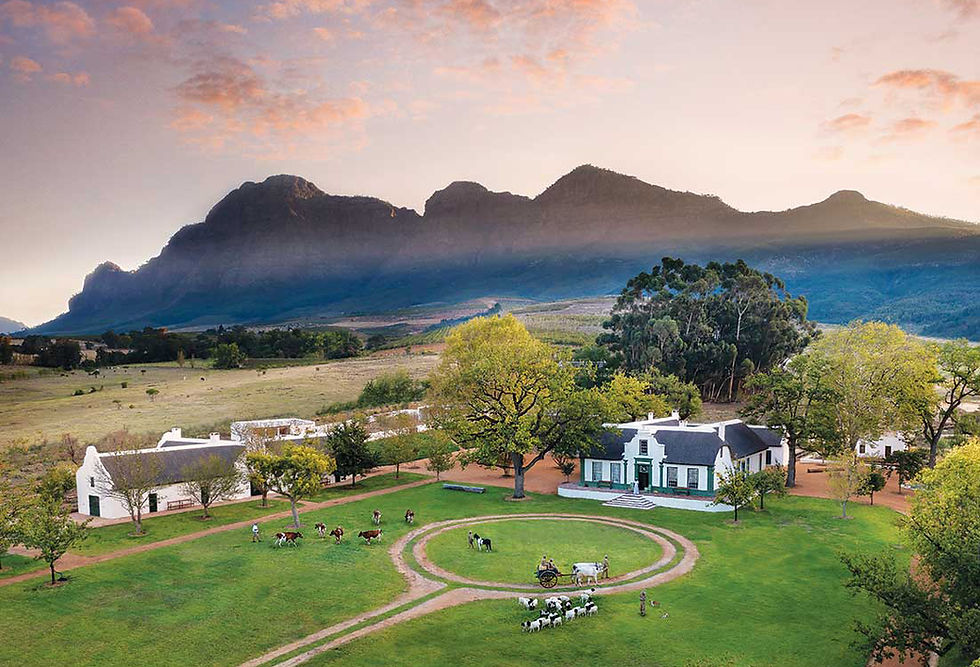
This is Babylonstoren's particular trick: the extraordinary delivered without announcement. A five-hectare garden that feeds three restaurants. A cellar producing 10 wines from slopes at 620 metres above sea level. A working dairy, a rice paddy, a bee museum, an online empire, an essential oil palace, workshops constantly, the farm has been here, in one form or another, since 1692, and every layer of it - the soil, the buildings, the animals, the food - has been tended to without flash. It simply shows up in the butter.
Once we go around the corner
The drive up Simonsberg Mountain begins at the reception gates. Axwyn, our activity guide, takes us up in a farm vehicle before dinner on the first evening. Winding past the trout dams, herds of wild buck on the lower pastures, an eland female standing in long shadow beneath a tree. She looks at the vehicle, unimpressed, and steps back into the foliage.
"Once we go around the corner," Axwyn says, "you will see paradise."

The Franschhoek ranges open across the valley in the last of the afternoon light. Table Mountain and Lion's Head against the horizon, Paarl and Franschhoek in the middle distance. The king proteas along the ridge are coming into bloom, the first blush of colour on the fynbos. Mphepho,a sacred indigenous African herb (genus Helichrysum) grows wild in the scrub beside the track.

Axwyn parks, carries a woven basket up to a wooden deck, sets out a picnic table, pours the wine. Celery with a citrus preserve. A few crackers. This olive harvest, he tells us, is the best in five years. The farm dates back to 1692, when Governor Simon van der Stel granted the free burgher Pieter van der Byl a piece of land at the foot of a conical hill — named, in Dutch, Babilonische Tooren, because the hill's shape reminded the first farmers of the Tower of Babel. More history is that the name also captures the linguistic collision which took place in the valley: Dutch, French, German, Khoi, San, and the words that arrived with the Asian spice trade, all tangled in etymology at the foot of the same mountain.
A southern boubou lands on the railing. Normally a shy bird, this one has learned where the crumbs will be deposited. It tiptoes forward and snaps up a dropped seed cracker, then holds its ground to assess the situation. "It's a regular," Axwyn says. Is it a tea spot or cheese-and-wine bird? We watch the sun drop behind the mountains and head back down to change for dinner.
The cottage
One of thirteen, built in Cape Dutch style on the footprints of the original farm labourers' quarters. Thick whitewashed walls, elegant gables, a fireplace with a good stack of wood beside it. Bookshelves with English and Afrikaans titles. A contemporary glass cube added onto the 18th-century structure holds the kitchen and dining area, and because it faces the garden entirely, the sense of being outside doesn't leave, even when you're in.
The bedroom has French roller doors opening straight into the en-suite bathroom. A claw-foot bath positioned to face the bed. The wooden floors were recycled from the old roof beams, we're told. Beside the front door, two helmets, two pairs of Wellington boots, lined up and expectant. The bicycles sit outside.
The guest book on the desk is thick with entries. Most are grateful to the point of gushing. A few pages near the back are children's drawings - small people, animals, a fat yellow sun. A woman we passed earlier in the garden, wrestling her toddler's shoes back on, had said, to no one in particular: "You can never run out of things to do here."
A welcome box on the counter holds seasonal fruit and a welcome note. We receive roasted almonds, olive oil, and fresh juice. Still water and sparkling at every turn. The farm finds small ways to keep you fed that feel less like a service and more like instinct. They know when you need what you need before you need it, you know?
Babel
Their ethos is alchemy, transforming the crumbling history into reinvented living. Their esteemed restaurant Babel is redesigned from the old cow shed. Floor-to-ceiling glass walls, white, clean and chic. This is farm-to-table, seasonal and what’s not made here, is sourced locally. In the orange candlelight, a harvest table is laid with nametags and offerings of what we will be eating tonight. This is The Library Table, a visual representation with origin, tasting notes, and maker.

The waiters wear large nametags, readable from across a table, which matters because you are served by the same people across multiple meals. The menu divides into Stirrings, Progression and Culmination. The season's first winter beetroot has come in, and it arrives simply, alongside Alta's cumin buffalo hangkop cheese. Two things that have no business being as right together as they are. The mozzarella with Adine's butternut atchar: creamy and bouncy, the zing of the pickle cutting straight through the milk fat. Cape Point tuna ceviche with buffalo yoghurt dressing and winter fennel, soft and cold and just shy of the acid tipping point. For Progression: Riebeek Kasteel lamb with braised butter beans and mint gremolata. The lamb gives at the fork. Each bite with a bean is its own small thing, a classic Mediterranean pairing done without complication. The dry-aged Chianina steak - from the farm's own herd - arrives with charred shallots in a mustard jus, the shallot bitter and sweet at once, cutting through the richness.

Across the room the kitchen is open-plan and in perpetual motion. The chef of the evening is focused,people come in and out with the ease of a kitchen that has found its rhythm. On the right side of the pass, a naked cake sits adorned with pressed flowers. I find it very hard not to stare at it. Target fixation.
A table of Americans near the door has established a handshake with one of the tall waiters during dinner,a sequence of moves they have rehearsed over the course of several courses. They cheer each other through it on the way out, laughing, getting it about half right as they push through the glass doors into the cold. Culmination: chocolate decadence, a citrus crème brûlée. Divine. We walk back, past chickens asleep on bicycle handlebars.
Kobus knows
We’ve seen the farm from above, and now in the early morning sun, we walk it with Kobus.
The morning walk starts with a little show, the White Peking ducks waddle out towards the vines, led by a duck herder, to eat slugs and snails, nature pest control and cutie patooties. We watch them take small dips in the puddles between the vines, sunlight catching in flecks of water on their feathers.
Kobus has been a guide here for 11 years. Previous guests had mentioned his name before we arrived,and as discussed, he knows everything. We crossed a wooden walkway over the dam. A cormorant lifts off a pole as we approach. Overhead, Weavers are mid-construction on their nests. We keep going, past Waterblommetjies on one side of the walkway, an Arborio rice paddy on the other. The birds developed a taste for it before the nets went up.
"When I started here 11 years ago, there were no nets," Kobus says. "We had two drummer boys making noise to chase the birds away until dawn. If the wind was blowing, you could hear them from the garden."
We follow a path into a stretch of forest, the river running fast and strong after recent rains. It's muddy. I ask whether anyone has ever attempted the walk in heels. He laughs and has had to politely nudge, “Ma'am, this is a walk , please go get your gumboots, otherwise you are not going to make it." There is a bamboo cave along this path, woven by hand and repaired after each storm. The buck sometimes shelter in it. "On two occasions I have been standing right here, and the buck ran out from inside," he says. "That is why I talk loudly."
There is so much consideration for nature here, you feel it, taste it, and hear it on any of the excursions offered.
A new addition to the farm is the Byzantium, a bee museum, fitting as there are over 100 hives, and a joyously thick, mouth-watering array of honeys for sale. We walk through the vegetable garden, bursting with herbs and small saplings in neat lines, basking in the sunlight.
Gundula's garden
The first thing Gundula Deutschländer talks about, arriving at the Healing Garden gate, are chickens. "To allow for regeneration," she says, "chickens come first." She has been part of the gardening team since Babylonstoren opened, tending to what she treats as something between a laboratory and a relationship.

She moves through the garden picking things up as she goes, offering everything out to taste and smell with the manner of someone whose enthusiasm has not dimmed from repetition. She crushes a fresh olive against her skin - a trick she learned during the pandemic - and holds her arm out. She pinches off the flowering head of the Acmella oleracea “toothache” plant, or Buzz Button, which looks something like a Liquorice Allsort, and tells us to taste it. Our mouths go numb. Little creatures have come to roam the bounty, the squirrels being cheeky fruit stealers.
“They take a bite and throw the fruit over their shoulders and wink at you. What they like changes every season.They started sharpening their teeth on the garden furniture in the hotel, which is imported from Paris.”
The Cape Sour fig (Carpobrotus edulis) is a living groundcover, also providing a softer landing for falling fruit. It grows along sand dunes on the coast, and medicinally comes with about seven varieties. She loves begonias. “A real Tannie plant” she says, plucking a red flower and lifting it to the sun. It sparkles like crystal. The garden is her child; she's been waiting all summer for the purple beans to ripen.
“Our story is very simple, it’s about you, the traveller finding refreshment again, like in the Cape. I love that everybody has an adventure here. The garden is so welcoming; people have their own personal relationships here. I’ve heard so many stories of our gardens as a companion.”
Her sanctuary is the Healing Garden, planted according to the human body, head to feet: herbs for the mind at the top, working down through the lungs, the stomach, the heart.
She stops at the cancer bush and explains its bitterness, its immune-building properties, the way the body receives it. There's an ashwagandha whose berries are so bitter even the birds won't touch them. A mountain marigold from high-altitude New Mexico that flowers for them in winter , "a friendly pot and a medicine pot," she says, "a cheerful antidepressant." She rolls a leaf of Artemisia between her fingers and holds it out; she tells us she tucks it inside her mask on flights.
"When I dug holes for these trees," she says, gesturing at beds dense with life, "I dug up so much rubbish. It was all dead. No earthworms, nothing." An installation of old pottery sits pressed into the soil nearby, a reminder of what the ground was before. "pottery, it's like digging through history."
"Our story is very simple," she says, near the end. "It's about the traveller finding refreshment again. The garden is so welcoming. People have their own personal relationships with it. I've heard so many stories of our garden as a companion."“As we’ve developed, we’ve gone back to our foundation.” That evening, we found a bunch of sour fig succulents and two small curry leaf saplings at our door to take home.
Wine
The winemaker's stated philosophy is truth to the area and simplicity. We descend into the wine tunnel with a group of strangers and sit at a long wooden table. Ten glasses. Before this we are taken through the winemaking philosophy, the industry and the innovation from man-made to machinery. Underground, it feels like another world.
The Sprankel opens with macadamia nuts. The Chenin Blanc brings sweet melon. By the Viognier, paired with jalapeño soft cheese, the table is laughing. The Sémillon with pastrami, the Chardonnay with almonds rolled in cheese. We're making conversation across the wood now, Then comes the second flight. The wines move on to the reds: Mourvèdre Rosé with trout, Babel with dark chocolate, Cabernet with biltong, Shiraz with Chianina chorizo. The Nebukadnesar, their flagship, comes last, paired with white chocolate-covered macadamia nuts. Ten wines representing the range of what these slopes can do. We leave a little buzzed for dinner.
La Serata
The Old Bakery’s Italian evening is served family style. Antipasti on wooden boards and a warm bubbly nature to the night. The pizza oven is behind us. I watch the chef prepare 17 pizzas, all sitting on a shelf, waiting to turn into crispy,gooey, perfection. Before this, one of the waiters steps forward and makes a warm introduction, taking us back to a small Italian farm. Then, the music gets louder. What I thought was blasting from the speakers is the prowess of an opera singer, who walks in between diners belting crisp soprano. I was in awe.
The room absorbs each song and applauds the performance. Then the next dance is the waiters with boards and slices to share. The ravioli is delicious. We stay at the table longer than we need to.
The farm before breakfast
The buffalo tour leaves early. We leave later. Our fault entirely, and Babylonstoren's response is to find us another guide and take us anyway, just the two of us, to Rietvlei on the lower part of the farm while the main group is already somewhere ahead.The herd is large: Molly, Patsy, Sina, and the others, enormous animals who nonetheless carry themselves with a particular passive calm. Each one returns to the same spot in the milking shed every day. If a new staff member joins the team, milk production drops 10 to 20 per cent while the herd adjusts. They are, it turns out, creatures of both great size and great feeling.

We walk into the dairy mid-session. The smell of warm milk, the mechanical rhythm of the equipment, the buffalo standing patiently in their stalls. Afterwards, the calves. Bottle-feeding a water buffalo calf is not graceful; they push hard at the bottle and your whole arm follows, but the focus on their faces while they drink is something else entirely. On the way out, a box where guests can submit name suggestions for new arrivals. We take this seriously. Puma and Shabby may one day join the herd.
Wind and mud and the view from the top
We took the bicycles out after all. Kei apples grow along the hedgerows - small, tart, bright yellow — and you can pick them as you pass, which we did, eating as we cycled. The Chianina cattle and one cow are curious when you cycle past them; the black bull is there for size reference. The Chianina are giants. Vast and white and placid, an ancient Italian breed.
At the dam, we decided to take out a canoe. Westerly had other ideas. Within minutes of getting onto the water, we had been pushed sideways across to the far bank, paddling hard against an imitable force. We used the oars to drag ourselves along the bank back to where we'd started, and we were drier at the beginning than the end, and it was very funny.
Cycling on, we hiked up the Babylonstoren hillock, the farm’s conical, towering namesake, visible from almost everywhere on the property. It's a proper climb. At the top, an old cannon, and below it, the whole farm laid out: the garden's geometry, the cottages, the winery. Along the base of a hedge below us, farm workers have stopped for their midday break. A neat row of green overalls stretched out on the grass in the sun, fast asleep. The wind rustles through the fynbos. We snacked on almonds.
The farm's first commercial wine harvest was in 2011. The garden was planted in 2009. When Karen Roos bought Babylonstoren in 2007, parts of the formal garden were dead dirt: no earthworms, no life. Gundula told us this herself, standing in beds so dense with growth that the squirrels are still getting above themselves and the chickens have claimed the bicycles.
What has been created since then- the mozzarella, the Sprankel, the sourdough, the Healing Garden, the buffalo calves waiting for names - are the result of years of patient, unglamorous work that the beauty of the farm doesn't hide so much as reward. The alchemy is real, it's handfuls of the soil.
Babylonstoren is located in the Cape Winelands, approximately one hour from Cape Town. The sunset mountain drive is available to guests staying two or more nights. Garden entrance is R150 per adult, valid for 12 months. babylonstoren.com


A truly inspiring read — Babylonstoren proves that patience, nature, and passion can turn humble soil into something magical. My grandpa plays one Bus Traffic Fever level every morning. When he gets stuck he calls me, and I quietly check bustrafficfever before answering.
Consolidating your social media presence often comes down to making the most of one profile slot. A dedicated bio link page helps you group your latest posts, portfolio pieces, and product pages without forcing followers to dig through a feed. For anyone juggling multiple content streams, this organized bio link page is a practical way to keep everything accessible and tidy.