

A Beginner’s Guide to Collecting South African Photography - With Gallery F
It’s a Saturday morning in May. The thickest mist I have ever seen has wrapped itself around the Cape Town City Bowl, snaking through the streets, stealing colour and re-rendering the world in hazy black and white.
I’m on my way to Gallery F, one of the top photographic galleries on the continent, and as I’m buzzed through the little black door at 78 Shortmarket Street, I step out of one monochromatic world and into another, climbing a staircase bracketed by exquisite black and white archival photographs by the likes of Ginger Odes, Billy Monk and David Lurie.
I’m here to meet Gavin and Sean Furlonger, the father-son partnership behind Gallery F, and after introductions are made and coffee prepared, we sit down to talk photography, starting with the exhibition currently up on the walls around us – Jessica Hilltout’s Amen.
It’s a collection of full-colour images captured over nine months of travel across the African continent in an old VW Beetle. Armed with a Hasselblad camera and 300 rolls of film, Hilltout explored grassroots football as a “shared language, shaped by creativity”, trading manufactured footballs for rag balls and photographs. It’s an extraordinary body of work. We page through Hilltout’s journals, laid out on tables around the room. They’re filled with handwritten notes on who she met, places she’d been and collages of smaller photographs she made with a battery-powered mini printer along the way. Lined up on a table nearby is the collection of rag balls Hilltout brought back with her.
Each ball and picture pulls a story in its wake, and it’s these stories – the stories behind the photographs – that Sean and Gavin find themselves the guardians of, just as much as the negatives and prints in their care. It’s a job they take seriously. Gavin founded Gallery F in 2002 as an extension of the Photographic Archival and Preservation Association of South Africa (PAPA-SA) – which he also started – an organisation that works to locate, preserve and protect South Africa’s historically significant photographic archives. Sean joined as partner and manager in 2020, focused on expanding the gallery’s footprint, both geographically with an extension into Europe, and digitally, with a new website and expanding social media presence. Across these two organisations, Gavin and Sean manage and care for some incredibly important photographic archives, along with the stories they hold, including names such as Billy Monk, Paul Alberts, Jodi Bieber, Juhan Kuus, Jurgen Schadeberg, Barry Lategan and Jillian Edelstein.
I ask Gavin – who himself is a renowned glamour and portrait photographer with a career spanning over 55 years – what drew him to archival and preservation work. “I kept hearing, ‘so-and-so passed away’, and (I wondered) where’s all his or her work? And they said, ‘I think the family binned it’...I heard that far too many times,” says Gavin. So he picked the two oldest photographers he knew – Ginger Odes and Desmond Bowes-Taylor – and asked them what they imagined happening to their work when they died. They had no idea. Gavin offered to take stewardship of their negatives, promising to keep the work alive. He received Ginger’s archive about a year after he died. He’s still waiting to receive Bowes-Taylor’s.
But it’s not easy. Photographic archives find their way to Gallery F in different degrees of degradation and disorder. “Sometimes we get given boxes of negatives that are meticulously labelled and preserved…some work we’ve received in black bags, where it’s just rolls of loose film thrown in, obviously getting damaged or scratched,” says Sean.
Next comes the painstaking process of negative preservation and archiving, in which the film is assessed, cleaned, re-sleeved, and then stored in an airtight box, with no dust or moisture coming in or out. After that, it’s manually digitised, mostly by Sean himself. The preservation work is an entirely self-funded, time- and resource-consuming process – a true labour of love. Gavin and Sean estimate that they have about a million negatives under their stewardship. Their dark room technician, Luke, thinks the number is much, much higher than that.

But for every archive Gavin and Sean have been able to save, countless more have been lost to rats, mould, moisture, or a chemical process called vinegarisation, when the film bubbles, becomes eroded and gives off a sharp smell. In many cases, important archives are simply chucked in the bin, mostly by family members who don’t realise the importance of the dusty old negatives taking up space in the garage.
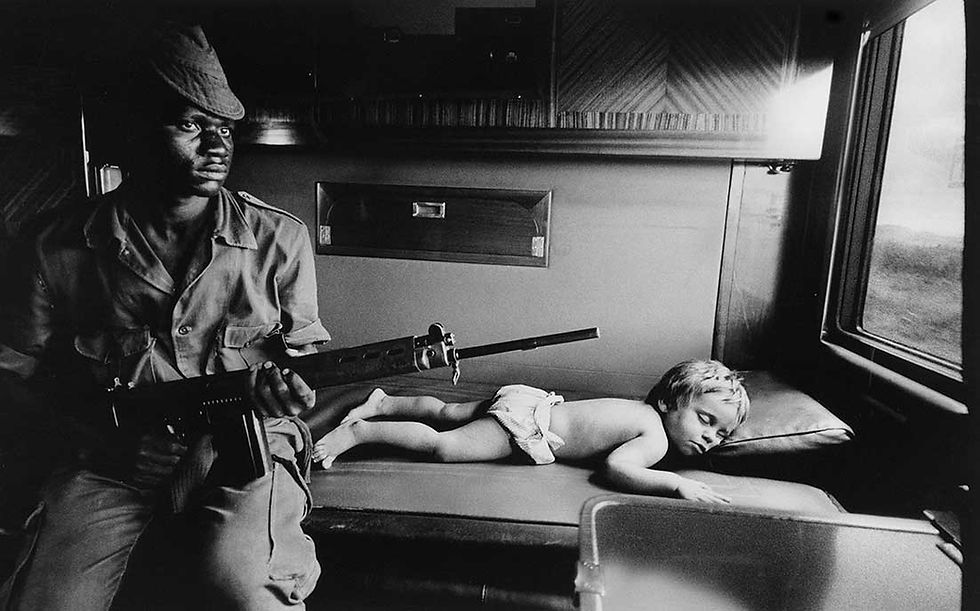
I ask Gavin why he feels this photographic archival and preservation work is so important. “Because this is our history,” he answers, “This is our legacy. This is a reminder of how our society has grown.” He moves over to a set of drawers and pulls out a piece of archival-quality paper to show me. It’s a handprint of “Patrol in Mozambique” by James Soullier, who worked as the Sunday Times’ Chief Editor and Photographer for over 30 years. The image shows a black soldier sitting in a train carriage with a rifle across his lap, guarding a white baby sleeping, cherubic, across the seat behind him. It’s a striking picture, rendered with perfect clarity by the master printer Dennis Da Silva. Wearing a pair of archivist’s white gloves, Sean shows me how to identify an original handprint – the paper is slightly wavy from being submerged in chemical and water baths during the handprinting process. The definition, detail, and contrast balance between the deep, rich black tones and crisp, clear whites is what’s so difficult to achieve. It can take many attempts to get that level of quality, Sean tells me. A master printer like Da Silva, who’s been doing this for 50 years, might get it right in two.

This is where a photographic print begins to gain its value – within the constellation of deep craft that surrounds its creation. Paper and ink quality, the size of the work, the number of editions, and the printing process used to create it (handprint vs. digital print) all contribute to value, as does whether or not the work is signed by the photographer, the printer, or both. The provenance of the work is also important, which is, as Sean explains, the history of the image as well as the history of the physical print itself. For example, if it’s a vintage handprint, i.e, one that was printed close to the time the photograph was taken, it may be more valuable than a more recent handprint made from that same vintage film. If it was made by a master printer, all the better!

If these factors come together in a combination that adds favourably to the print's collectability, it may well appreciate in monetary value to a startling degree after only a few years. Photography can be a sound financial investment. But, as Gavin and Sean insist, making money is not the right motivation for starting a collection. Begin, rather, with your own taste. “First of all, does (the photograph) touch you? And if it does, then it's a good start,” says Gavin. “I would always say, to start with, buy something you absolutely love that you can afford. Don’t think about editions or sizes, or any of that, because it can really throw you off…If you like the picture, and you want to support (the photographer), that should be the driving factor.” From there, if you’re looking to build a collection, you can start figuring out things like editions, researching photographers, and so on. “And if you’re collecting as a youngster, buy young photography, because it’ll grow with you.”

A good place to start? Gallery F’s website is a remarkable resource, with a wonderful blog explaining everything a beginner collector needs to know. You can also view work from the outstanding cohort of photographers they represent, both archival and contemporary.
And next time you’re in Cape Town, pop by Gallery F. While the world of galleries, editions and print collecting may seem intimidating, it’s made all the more accessible by people like Sean and Gavin – passionate, approachable and likely to invite you to sit for a cup of coffee and a story or two.

Gallery F
78 Shortmarket Street, Cape Town
Open 9.45 am-5 pm, Monday to Friday
Saturdays, by appointment only


For a business looking to refine its approach, the platform's focus on progressive business development is worth noting. It suggests a methodology that goes beyond basic lead generation and looks at the entire process of turning data into revenue.